Advanced Satellite Aviation Weather Products (ASAP) Program
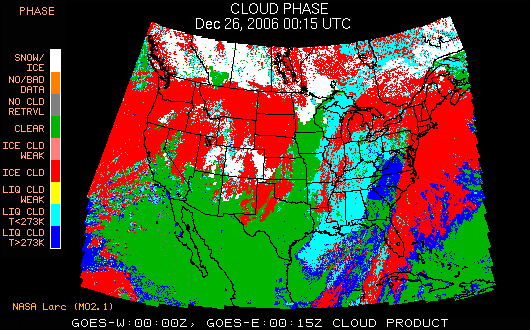
The goal of the Advanced Satellite Aviation Weather Program is to increase and optimize the usage of satellite data sets within the existing FAA Product Development Team (PDT) structure and to transfer advanced satellite expertise to the teams. For in–flight icing, we are addressing this goal by acquiring and evaluating GOES–derived cloud microphysics products developed by the NASA Langley Cloud and Radiation Research Group and by experimenting with methods to integrate those products into the NCAR Current Icing Product (CIP). We have conducted multiple evaluation efforts including comparisons of the satellite–derived cloud products with research aircraft data, voice pilot reports (PIREPS), and ground–based measurements using a case–study approach. We also performed a preliminary integration of the satellite–derived phase and liquid water path products into CIP for a set of single layer cloud case studies.
Highlights
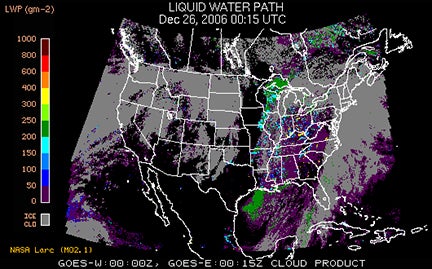
NCAR staff have collaborated with NASA Glenn Research Center flight crews to forecast and monitor icing conditions for Twin Otter icing missions since 1998. The past two years they incorporated the NASA Langley satellite products into their forecast procedures. Several products were found to be useful for diagnosing where icing is and is not; liquid water path (LWP, the total integrated liquid through an atmospheric column) was found to be one of the more promising products. While there is no reason to expect a direct correlation between LWP the actual liquid water content at any point in a cloud (and thus icing conditions experienced by aircraft flying there), LWP appeared to be well–related to the presence of icing encountered by the Twin Otter. To test this concept more quantitatively, a set of PIREPs stratified by reported severity level was compared to LWP. While the variation of LWP with severity category was not strictly monotonic, there was a positive correlation between the two quantities. This demonstrated feasibility for inclusion in the CIP fuzzy–logic algorithm, which seeks clues for the presence of icing conditions.
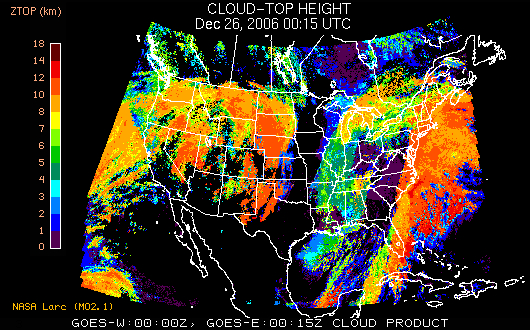
Results suggest that the NASA Langley products can significantly improve the current CIP cloud top height scheme. The blended scheme can reduce the cloud top height, icing volume, and perhaps the false alarm rate significantly while minimizing loss of probability of detection of icing locations. Improvements are most evident in daytime when all satellite channels are available and fields are smooth and uniform; night time satellite–based schemes will require smoothing or filtering to handle noisy–appearing data.
Future Plans
This project has ended.
Publications
Bernstein, B., F. McDonough, C. A. Wolff, M. K. Politovich, G. Cunning, S. Mueller, and S. Zednik, 2006: The new CIP icing severity product. 12th Conference on Aviation Range and Aerospace Meteorology Atlanta, GA, Amer. Meteor. Soc., Boston. Download PDF
Bernstein, B., F. McDonough, M. K. Politovich, B.G. Brown, T.P. Ratvasky, D.R. Miller, C. A. Wolff, and G.Cunning, 2005: Current icing potential: Algorithm description and comparison with aircraft observations. J. Appl. Meteor., 44, pp. 969–986. Download PDF
Black, J., F. McDonough, J. Haggerty, S. Landolt, B. Bernstein, C. Wolff, and P. Minnis, 2007: Comparison of NASA–Langley satellite–derived cloud top microphysical properties with research aircraft data. 23rd Conference on Interactive Information Processing Systems for Meteorology, Oceanography, and Hydrology, Amer. Meteorol. Soc., San Antonio, TX, 14–18 January. Download PDF
Haggerty, J., G. Cunning, B. Bernstein, M. Chapman, D. Johnson, M. Politovich, C. Wolff, 2005: Integration of advanced satellite cloud products into an icing nowcasting system. Presented at World Weather Research Program Symposium on Nowcasting and Very Short Range Forecasting, Toulouse, France, 5–9 September. Download PDF
Haggerty, J., C. Wolff, M. Chapman, S. Landolt, and P. Minnis, 2006:Evaluation of satellite–derived cloud products in supercooled liquid clouds. In preparation for submission to J. Appl. Meteorol.
Wolff, C.A., B.C. Bernstein and F. McDonough, 2004: Nowcasting aircraft icing conditions using GOES–derived satellite products. Presented at World Weather Research Program Symposium on Nowcasting and Very Short Range Forecasting, Toulouse, France, 5–9 September.Download PDF
Contact
Please direct questions/comments about this page to:
Julie Haggerty
Project Scientist III