CONUS404 and CONUS404 PGW
CONUS404
Animation of 40 years of CONUS404 2D variables: outgoing longwave radiation (white), precipitation rate (blue to yellow indicating low to high value), and water vapor mixing ratio at 2 m (brown to green indicating low to high value). Fields representing time scales from hour to decade are shown to illustrate the transition from weather to climate, which highlights the advantage of the CONUS404 dataset for research topics across time scales. Courtesy of NSF NCAR CONUS404 and CISL ViSR teams. CONUS404 Data Set: rda.ucar.edu/datasets/d559000/ Visualization Software: www.vapor.ucar.edu
-
Long-Term Regional Hydroclimate Reanalysis over the CONUS
Description
Rasmussen, R. M., and Coauthors, 2023: CONUS404: The NCAR–USGS 4-km Long-Term Regional Hydroclimate Reanalysis over the CONUS. Bull. Amer. Meteor. Soc., 104, E1382–E1408, https://doi.org/10.1175/BAMS-D-21-0326.1.
Abstract
A unique, high-resolution, hydroclimate reanalysis, 40-plus-year (October 1979–September 2021), 4 km (named as CONUS404), has been created using the Weather Research and Forecasting Model by dynamically downscaling of the fifth-generation European Centre for Medium-Range Weather Forecasts (ECMWF) atmospheric reanalysis of the global climate dataset (ERA5) over the conterminous United States. The paper describes the approach for generating the dataset, provides an initial evaluation, including biases, and indicates how interested users can access the data. The motivation for creating this National Center for Atmospheric Research (NCAR)–U.S. Geological Survey (USGS) collaborative dataset is to provide research and end-user communities with a high-resolution, self-consistent, long-term, continental-scale hydroclimate dataset appropriate for forcing hydrological models and conducting hydroclimate scientific analyses over the conterminous United States. The data are archived and accessible on the USGS Black Pearl tape system and on the NCAR supercomputer Campaign storage system.
Applications
Since its release in late 2023, the CONUS404 dataset has been used in a variety of studies. A repository of applications is currently under development. The table below provides a qualitative comparison of hydrological model forcing datasets. Noting that future projections are covered by the CONUS404 PGW.
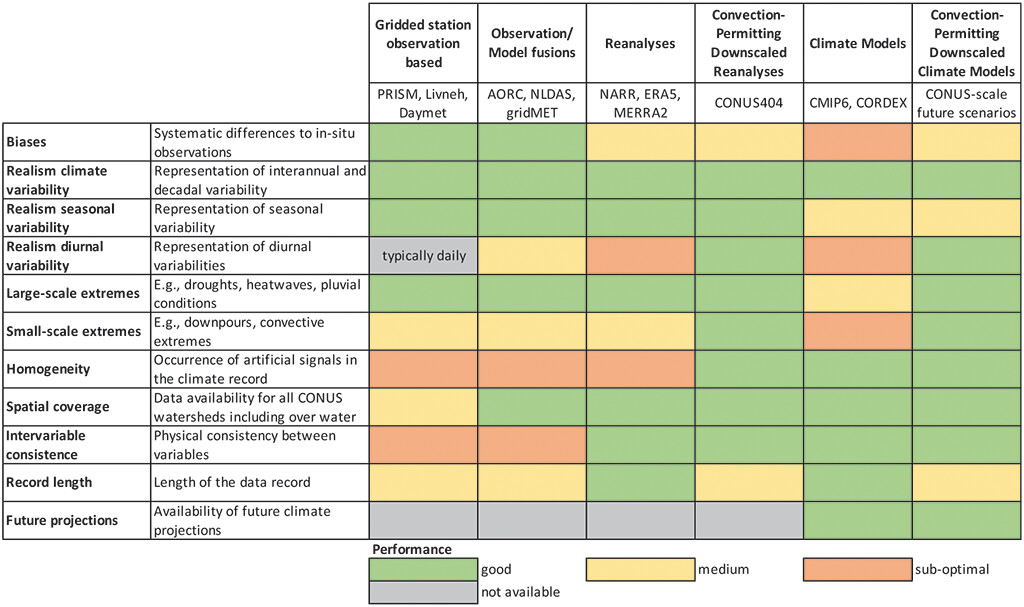
Good performance means that datasets have higher skill compared to others while suboptimal performance is interpreted relatively to other datasets.
Citation: Bulletin of the American Meteorological Society 104, 8; 10.1175/BAMS-D-21-0326.1
CONUS404 PGW
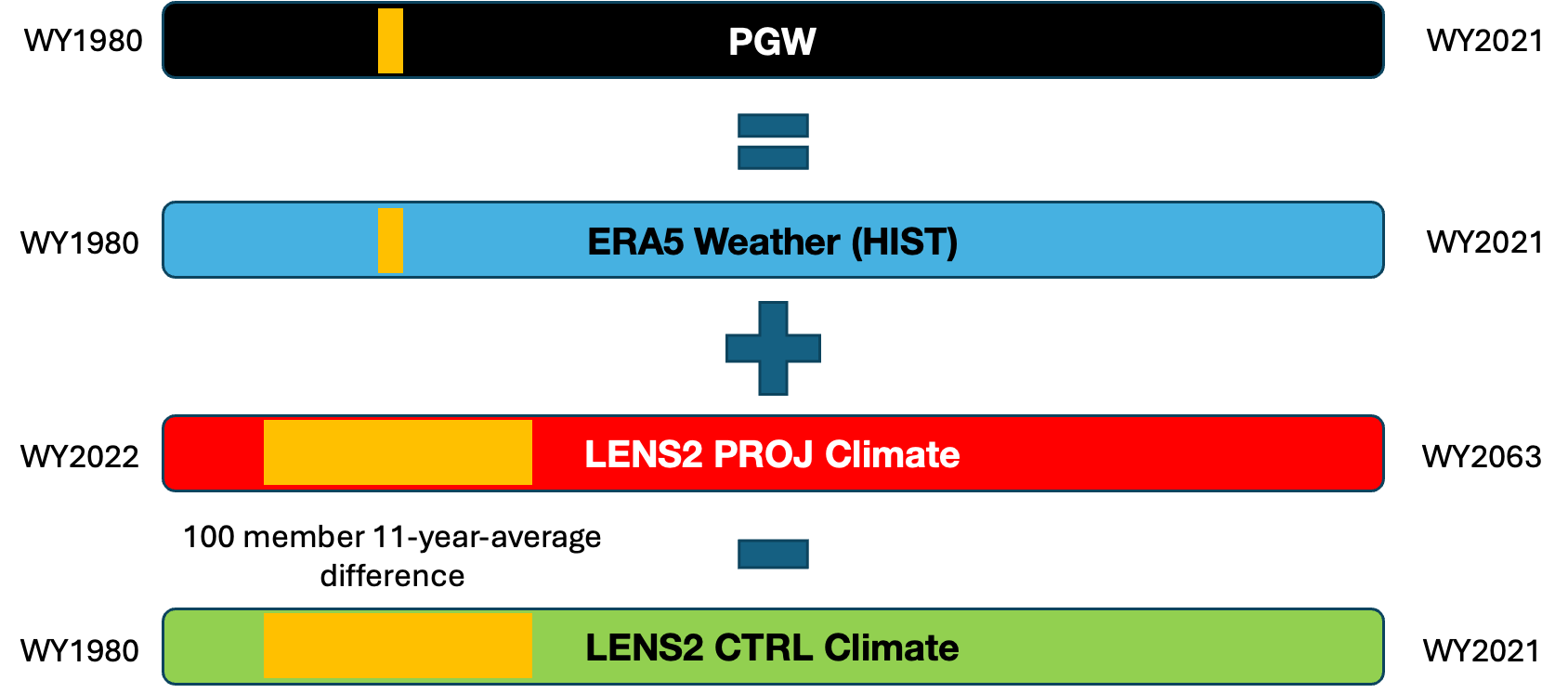
Schematic of the construction of the PGW forcing. The monthly perturbations are extracted between the PROJ and CTRL ensemble means within a moving 11-year window centered at the processed year.
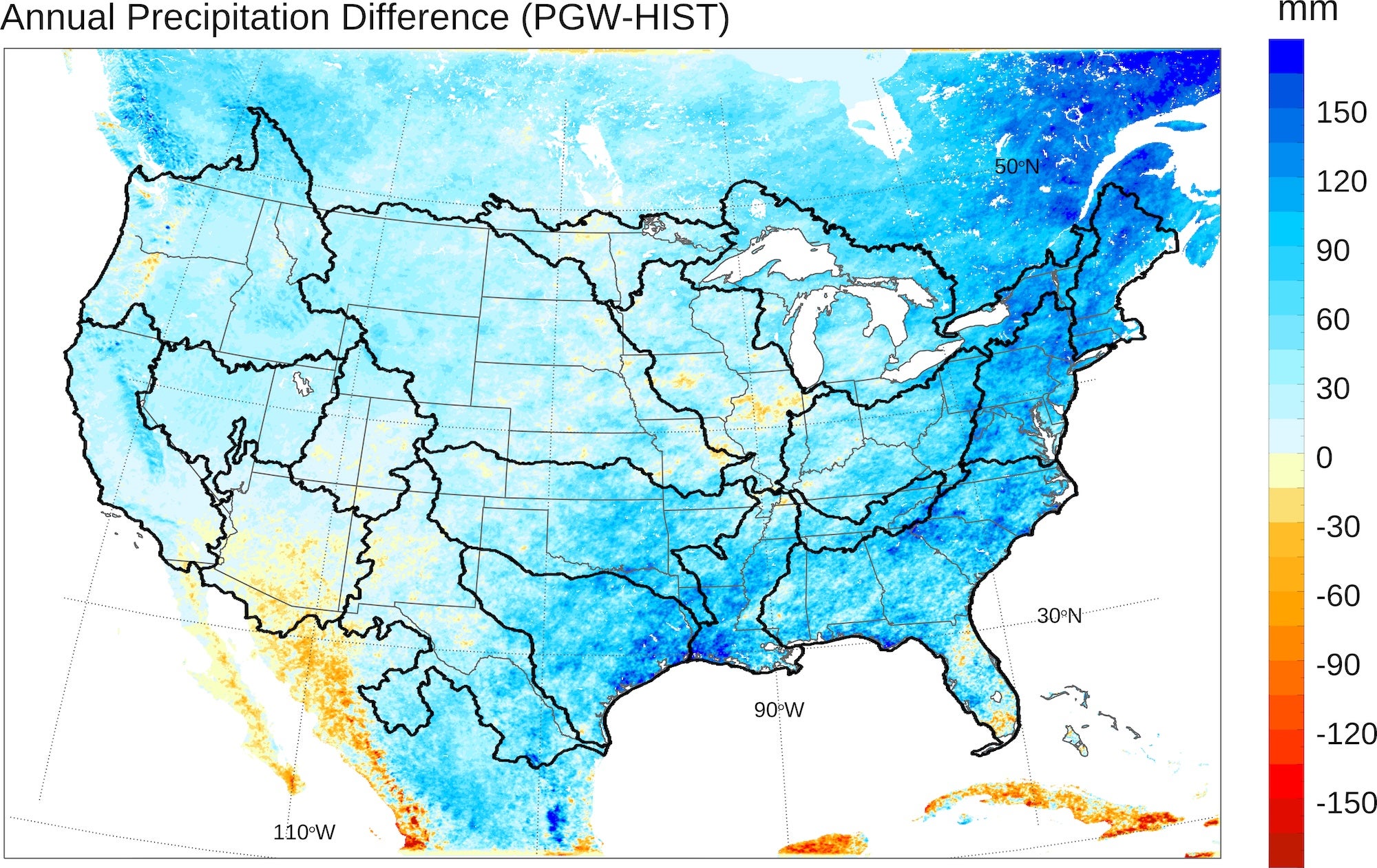
The 45-year average annual precipitation difference between the CONUS404 PGW (wy2022-wy2056) and CONUS404 HIST (wy1980-wy2024) datasets
-
Published Dataset
Description
Manuscript is currently in progress. For now, see the published dataset.
Abstract
The CONUS404 PGW dataset is a future-perturbed hydro-climate dataset, created as a follow on to the CONUS404 dataset. The CONUS404 PGW dataset represents the weather from 1980 to 2021 under a warmer and wetter climate environment and provides an opportunity to explore the event-based climate impacts when used with the CONUS404 historical data. This dataset has sufficient temporal and spatial detail to resolve probable mesoscale atmospheric states and processes in a future warmer climate, making it appropriate for forcing hydrological models and conducting meteorological analyses to study one possible scenario of climate and resultant hydrologic impacts over the conterminous United States (CONUS). CONUS404 PGW was produced by the National Center for Atmospheric Research (NCAR) Weather Research and Forecasting (WRF) Model simulations, forced with ERA5 reanalysis data plus LENS2 projected climate perturbations (additional details of the simulation and cross-references to the input datasets are described in the metadata).
This simulation was run by National Center for Atmospheric Research (NCAR) as part of a collaboration with the U.S. Geological Survey (USGS) Water Mission Area. CONUS404 PGW includes 42 years of data (water years 1980-2021, October 1, 1979 - September 30, 2021), and the spatial domain extends beyond the CONUS into Canada and Mexico, thereby capturing transboundary river basins and covering all contributing areas for the CONUS surface waters.
This data release provides metadata and data dictionaries for this dataset and directs users toward multiple means for obtaining the CONUS404PGW data. Any use of trade, firm, or product names is for descriptive purposes only and does not imply endorsement by the U.S. Government.
Applications
Since its release in late 2024, the CONUS404 PGW dataset has been used in a wide range of studies. A repository of applications is currently under development.
Related Publications
-
Publications
Description
2026
Bauer H, Hiraga Y, Kazama S. Historical Changes in Snow Conditions for Skiing Across the Contiguous United States Based on SNODAS-Validated CONUS404 Reanalysis. Environmental Research Communications. 2026 Jan 30. DOI 10.1088/2515-7620/ae3fee
Bytheway JL, Mahoney KM. Representation of Extreme Precipitation in High-Resolution, Long-Period-of-Record Precipitation Datasets over the Continental United States. Journal of Hydrometeorology. 2026 Jan;27(1):85-106. https://doi.org/10.1175/JHM-D-25-0085.1
Chen X, Leung LR, Ullrich P. Object-based Evaluation of Dynamical and Statistical Downscaled Precipitation Products over CONUS. Bulletin of the American Meteorological Society. 2026 Feb 11:BAMS-D. https://doi.org/10.1175/BAMS-D-24-0325.1
Lybarger ND, Lybarger ND, Gutmann ED, Newman AJ, Mueller C, Hartke SH, Rasmussen S, Warner MD, Wood AW. Evaluating Statistical Downscaling Techniques for Regional Hydroclimatic Change Projections over CONUS. Authorea Preprints. 2026 Feb 13.
Sha Y, Hertneky T, Gutmann E, McGinnis S, Xue L, Gagne II DJ, Newman K, Newman A. AI-based Regional Emulation for Kilometer-Scale Dynamical Downscaling. arXiv preprint arXiv:2602.18646. 2026 Feb 20.
2025
Dougherty, E.M., S. A. Tessendorf, and A. DeCastro, 2025: Historical changes in snow, rain, and dry days in the East-Taylor River Basin, Colorado. J. Hydromet., 26, doi: https://doi.org/10.1175/JHM-D-24-0153.1.
Guilloteau C, Chen X, Leung LR, Foufoula‐Georgiou E. Hourly precipitation intensities at 4‐km resolution show statistically significant increasing trends from 1991 to 2022 in the CONUS‐404 hydroclimate reanalysis. Geophysical Research Letters. 2025 Oct 28;52(20):e2025GL117588. https://doi.org/10.1029/2025GL117588
Li W, Pan B, Li T, Nai C, Li Z, Chao J, Lu B, Duan Q, Pan M. Latent diffusion model for quantitative precipitation estimation and forecast at km scale. Environmental Modelling & Software. 2025 Sep 19:106701.
Nerantzaki, S. D., Abdelmoaty, H. M., Papalexiou, S. M., & Newman, A. J. (2025). The influence of atmospheric drivers, environmental factors, and urban land use on extreme hourly precipitation trends over the CONtiguous United States for 40 years at 4-km resolution (CONUS404). Science of the Total Environment, 969, 178407. https://doi.org/10.1016/j.scitotenv.2025.178407
Nie X, Shi X. Contraction of the Maximum-Rain Radius in Intense North Atlantic Tropical Cyclones. Authorea Preprints. 2025 Dec 24.
DOI: 10.22541/essoar.176659758.81540156/v1
(preprint - not peered reviewed)
Qin, H., Alvee, F. M., Leung, L. R., Sun, X., & Wang, G. (2025). Performance of Convection-Permitting and Convection-Parameterized Models in Reproducing the Extreme Precipitation Intensity Relationship with Surface Conditions. Journal of Climate, 38(17), 4611-4623. https://doi.org/10.1175/JCLI-D-24-0589.1
Ritchie, E., Wood, A. W., Johnson, R., Marshall, A., Sturtevant, J., Liljestrand, D., and Golitzin, E. (2025) Benchmarking Catchment-Scale Snow Water Equivalent Datasets and Models in the Western United States, EGUsphere [preprint], https://doi.org/10.5194/egusphere-2025-5514
Schumacher R, Hill AJ. Extreme precipitation in the contiguous US in gridded analyses and a convection-permitting model simulation. Authorea Preprints. 2025 Dec 12. https://doi.org/10.22541/essoar.176556339.99427907/v2
(preprint - not peered reviewed)
Thompson, L., Wang, C., He, C., Lin, T. S., Liu, C., & Dudhia, J. (2025). Assessment of convection-permitting hydroclimate modeling in urban areas across the contiguous United States. Urban Climate, 61, 102375. https://doi.org/10.1016/j.uclim.2025.102375
Vo, T. T., Hu, L., Xue, L., & Chen, S. (2025). Trends in Cloud Covers across CONUS (1980–2020). Journal of Climate, 38(19), 5371-5390. https://doi.org/10.1175/JCLI-D-24-0602.1
Wang, F., & Tian, D. (2025). Hourly Evaluation of Eight Gridded Precipitation Datasets over the Contiguous United States: Intercomparison of Satellite, Radar, Reanalysis, and Merged Products. Journal of Hydrometeorology, 26(11), 1717-1733. https://doi.org/10.1175/JHM-D-25-0063.1
Zhu S, Tang G, Yan S, Du Y, Xu Y, Zhang M, Chen M, Li H, Hong Y. A new approach to identifying and analyzing precipitation events and their typical lifecycles over conterminous United States. Geophysical Research Letters. 2025 Jul 28;52(14):e2025GL115640. https://doi.org/10.1029/2025GL115640
2024
Rafieeinasab, A., Mazrooei, A., Enzminger, T., Srivastava, I., Dugger, A., Gochis, D., Omani, N., Grim, J., Sampson, K., Zhang, Y., LaFontaine, J., Viger, R., Liu, Y., and Schneider, T.: A WRF-Hydro-based retrospective simulation of water resources for US integrated water availability assessment, Hydrol. Earth Syst. Sci. Discuss. [preprint], https://doi.org/10.5194/hess-2024-262, 2024.
Zhang, Y., Grim, J.A., Cabell, R.S., Srivastava, I., Gochis, D.J., Prein, A.F., Rasmussen, R.M., Ikeda, K. and Schneider, T.L., 2024. CONUS404 climate forcing variable subset for hydrologic models, 1979-2022: Downscaled to 1 km and bias-adjusted for precipitation and temperature. US Geological Survey (USGS) Data Release, p.640. doi:10.5066/P9JE61P7
Zhu, L., & Simpson, I. (2024). An Intercomparison of Water Vapor Trends in the US Southwest between CONUS404, CMIP Models, and Observations. NCAR Report. https://opensky.ucar.edu/system/files/2025-06/26_zhu_080124_6.pdf
2023
Abolafia-Rosenzweig, R., C. He, F. Chen, K. Ikeda, T. Schneider, and R. Rasmussen (2023): High Resolution Forecasting of Summer Drought in the Western United States, Water Resources Research, 59, e2022WR033734, https://doi.org/10.1029/2022WR033734
Rasmussen, R. M., Chen, F., Liu, C.H., Ikeda, K., Prein, A., Kim, J., Schneider, T., Dai, A., Gochis, D., Dugger, A., Zhang, Y., Jaye, A., Dudhia, J., He, C., Harrold, M., Xue, L., Chen, S., Newman, A., Dougherty, E., Abolafia-Rosenzweig, R., Lybarger, N. D., Viger, R., Lesmes, D., Skalak, K., Brakebill, J., Cline, D., Dunne, K., Rasmussen, K., & Miguez-Macho, G. (2023). CONUS404: The NCAR–USGS 4-km Long-Term Regional Hydroclimate Reanalysis over the CONUS. Bulletin of the American Meteorological Society, 104(8), E1382-E1408. https://doi.org/10.1175/BAMS-D-21-0326.1
Rasmussen, R. M., C. Liu, K. Ikeda, F. Chen, J. Kim, T. Schneider, D. Gochis, A. Dugger, and R. Viger. 2023. Four-kilometer long-term regional hydroclimate reanalysis over the conterminous United States (CONUS). NSF National Center for Atmospheric Research. https://doi.org/10.5065/ZYY0-Y036