Main navigation

NCAR Logo
Research Applications Laboratory
Contact Us
  • About
    • Leadership
    • Programs
    • Education + Outreach
    • Ethics + Integrity
    • Staff
    • Awards and Patents
    • RAL Advisory Panel
    • Fact Sheets
    • Contact
    • Publications
  • What We Do
    • Agriculture + Food
    • Air Quality
    • Aviation
    • Climate
    • Human Health
    • Renewable Energy
    • Surface Transportation
    • Testing + Evaluation
    • Tropical Cyclones
    • Urban Weather
    • Water
    • Wildfire
  • Products + Tools
  • Technologies
    • Artificial Intelligence and Machine Learning
    • Atmospheric Surface Measurements and Evaluation
    • Cloud Computing and Software Containers
    • Data Assimilation
    • Data Services
    • Decision Support Systems
    • Forecasting Systems
    • Geographic Information Systems (GIS) Science
    • Measuring Forecast Quality
    • Regional Climate Analysis and Impact
    • Specialty Models
  • Impacts
    • Overview
    • Agriculture + Food Impacts
    • Air Quality Impacts
    • Aviation Impacts
    • Climate Impacts
    • Tropical Cyclones Impacts
    • Human Health Impacts
    • Renewable Energy Impacts
    • Surface Transportation Impacts
    • Testing + Evaluation Impacts
    • Urban Weather Impacts
    • Water Impacts
    • Wildfire Impacts
  • Work With Us
    • Community Collaboration
    • Internships and Fellowships
    • Licensing for Technology Transfer
    • Partner With Us
    • Sponsors
    • Visitor Programs
    • Workshops and Tutorials
    • Jobs
  • Events
    • Upcoming
    • Past
    • Live Broadcast
  • News
Contact Us

Breadcrumb

  1. Home

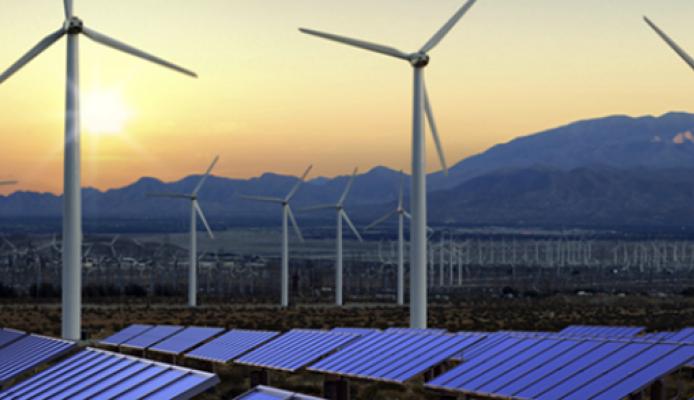
iStock_000008502964Large_sm.jpg

Renewable Energy

Advanced Technologies for Renewable Energy Prediction

NCAR is uniquely qualified to help support our nation's transition to renewable energy due to NCAR's breadth of atmospheric science knowledge, experience with technology transfer, and access to university researchers. These capabilities led NCAR to include a new research frontier in the 2009 NCAR Strategic Plan.

NCAR will develop methods to more accurately assess and predict wind and cloud cover (insolation) in support of renewable energy industries. Understand the impacts of biofuels and other renewable energy technologies on water resources and regional climate.

Shifting the nation's energy portfolio toward renewable energy sources, such as wind, solar power, and biofuels, is a national priority. Atmospheric science has a role in developing these resources: important meteorological and climatic factors influence the amount of energy available from these sources, and renewable energy developments themselves can have climate and environmental impacts.

Improved understanding of the atmospheric boundary layer and the interaction of flow regimes with variable topography is crucial for developing wind resources. There is now widespread recognition that poor characterization of the atmospheric conditions (e.g., wind shear, turbulence) in which wind turbines operate is hindering the development of their energy–generation potential: wind farms are under–producing by 15–20%, and turbines that are designed for a 20–year lifetime are failing in less than five years. The efficiency of future power grids can be substantially improved by using accurate and detailed short–term weather predictions to control renewable power generation systems. New sensors and weather prediction systems are needed for future grids that may include energy storage components. Finally, in the area of biofuels, cultivating new crops for scaled up production could significantly change land–use patterns, which, in turn, could negatively impact soil erosion, water resources, and regional climate. NCAR has significant expertise in all of these areas. We plan to work with collaborators to develop weather and climate research programs focused on:

  • Infrastructure planning and management, such as boundary layer studies and characterization of land use interactions with regional climate
  • Develop partnerships with the National Renewable Energy Laboratory, commercial weather service providers, and industries that are investing in wind power systems to develop, evaluate, and improve sensor technology, observational systems, and short-term wind prediction systems
  • Investigate the potential value of improved short–term and seasonal weather prediction for determining energy demands, management of energy supply, pricing and markets, system operations and regulatory compliance, and minimization of economic risk

Partners

  • Electric Power Research Institute
  • Government of Bangladesh (GOB)
  • Harness Energy  (USAID)
  • New York Power Authority
  • New York State Energy Research and Development Authority
  • NREL
  • U.S. Department of Energy Office of Energy Efficiency & Renewable Energy
  • Vaisala
  • Xcel

Resources

  • Handout - Advanced Forecasting for Renewable Energy (1.19 MB)

Contact

Sue Ellen Haupt

Senior Scientist, Research Applications Laboratory

email

OUR IMPACTS

  • FastEddy®: A GPU-Accelerated Microscale Model
  • Generating Automated, Timely, Accurate Forecasts Globally 10 Days Out
  • Improving Solar Power Forecasting
  • Providing Wind Forecasts to Utility Companies
  • Renewable Energy Impacts

RELATED PRODUCTS

  • Analog ensemble (AnEn)
  • Analog Kalman Filter (AnKF)
  • Distributed Solar Energy Prediction
  • Empirical Wind-to-Energy Conversion Algorithm
  • Ensemble-RTFDDA
  • FastEddy®
  • Fine-Scale Analysis and Nowcast System (FINECAST®)
  • GRAFS (GRidded Atmospheric Forecast System)
  • Load Prediction System
  • MAD-WRF
  • Renewable Energy Forecasting for Kuwait
  • RTFDDA-LES
  • Solar Energy Prediction System - Sun4Cast®
  • VDRAS
  • Wind Energy Prediction System
  • WRF-Solar®
  • WRF-Solar® EPS
  • WRF-Solar® V2

RELATED PROJECTS

  • NCAR's Contribution To Wind And Solar Energy Prediction
  • Solar Power Forecasting Partnership

NSF NCAR

  • NSF NCAR Homepage
  • ACOM | Atmospheric Chemistry Observations & Modeling
  • CGD Laboratory
  • CISL | Computational & Information Systems
  • EdEC | Education, Engagement & Early-Career Development
  • EOL | Earth Observing Laboratory
  • HAO | High Altitude Observatory
  • MMM | Mesoscale & Microscale Meteorology
  • RAL | Research Applications Laboratory

UCAR

  • UCAR Homepage
  • Community Programs
  • Education & Training
  • For Staff
  • Government Relations & External Engagement
  • Member Institutions
  • Tech Transfer & Engagement
  • University Collaboration

RAL

  • Main Phone: 303-497-8422

  • For RAL Staff

Follow RAL


© 2026 UCAR

  • Privacy
  • Cookies
  • Web Accessibility
  • Terms of Use
  • Copyright Issues
  • Sponsored by U.S. NSF
  • Report Ethics Concern
  • Staff Login
Postal Address: P.O. Box 3000, Boulder, CO 80307-3000 • Shipping Address: 3090 Center Green Drive, Boulder, CO 80301
NSF Logo

This material is based upon work supported by the NSF National Center for Atmospheric Research, a major facility sponsored by the U.S. National Science Foundation and managed by the University Corporation for Atmospheric Research. Any opinions, findings and conclusions or recommendations expressed in this material do not necessarily reflect the views of the U.S. National Science Foundation.